
 Last week the Supreme Court voted 5 to 4 to legalize same sex marriage, granting homosexuals multiple civil rights that heterosexuals have enjoyed since the United States declared independence from Great Britain. Finally gay men and women are free to marry whomever they choose in all 50 states. The gay family nest has been legitimized—not only by TV shows like American Family—but in the real world. Think of all the changes that will unfold as a result of legitimizing love between same gender couples: ease of adoption, marital privileges upon illness and death, including hospital visitation, burial rites, estate planning and much more. Children raised by gay parents will grow up alongside the offspring of hetero parents; they’ll interact in pre-school, on the playground and in college classrooms. In one generation, the new normal can begin to replace much of the prejudice, pre-conceived and outdated beliefs about who can—and should—marry whom.
 college culture? The effect of gay marriage on the evolution of education remains to be seen. But I can give you an example of the changes that have occurred since the late 70’s when I went to Vassar. At that time, there was no major in African Studies, but 40 years later most colleges offer that area of concentration. And whoever heard of hip-hop as a freshman English course? Yet in 2010, my son Max wrote and studied hip-hop at Vassar.
  While Pace University’s OASIS program did an excellent job of tutoring and advocating for Sarah and other students with high-functioning autism, none of these students were truly embraced or integrated by their neurotypical peers. On the contrary, they were isolated (as if for everybody’s mutual protection?) No one even tried integrating the OASIS students with neurotypical students for any organized exchange of ideas, values and perspectives. Consider the potential mutual benefits of fostering such an integration. First, invite Temple Grandin, John Robison and other speakers to address incoming freshman on how various aspects of autism enrich the neurotypical perspective. Second, appoint student ambassadors (with and without autism) to develop respect, patience and empathy on the part of the neurotypical students. Offer students opportunities to apply compassion in action, instead of merely giving lip service to our appreciation for the differences in others. Neurotypical thinkers might be inspired or facilitated by ideas from the perspective of those on the spectrum. Above all, the desegregation of people on the spectrum with neurotypical folks can only lead to greater understanding and mutual benefit. That doesn’t mean this kind of program would be EASY to establish. But consider the alternative: an increasingly marginalized population of aging adults on the spectrum (who are NOT cute like little kids) and who will require a lifetime of care-taking and dependence. Do we really want to take on that challenges as a culture? Remember 1 in every 68 babies is currently born on the spectrum, and that number is rising every year.
Everyone ends up a winner. The neurotypical and the ASD student gain valuable job experience and emotional training by working with others who see the world differently; and the world benefits from college graduates with diverse perspectives and abilities who know how to interact effectively,. After four years of living, learning and working together, maybe neurotypical grads will WANT to hire their ASD friends and fellow alums. In addition, the students with autism will spend four years learning new social skills and perhaps be better prepared and more confident when looking for that first elusive job out of college. Perhaps then people in the neurotypical world will become partners with those on the spectrum—not only in technology, engineering and computer companies but also in the arts, entertainment and education. Such a collaboration is bound to yield yet another win—a better working world for all of us.

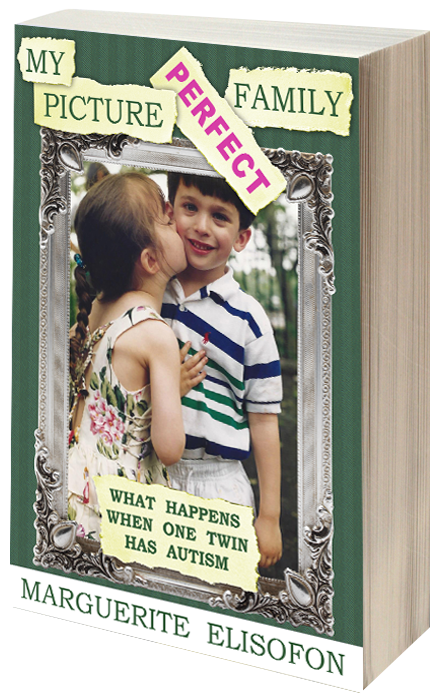
 Marguerite Elisofon is a New York City writer and the author of My Picture Perfect Family, a memoir about how her family navigated life with a child on the autistic spectrum before the internet and support groups existed. She also blogs about parenting young adults and disability related issues in The Never Empty Nest. Her writing has been featured in a variety of publications, including Time and NY Metro Parents magazine, and her family’s story has been featured by the NY Post, Fox News, The Daily Mail, and on Jenny McCarthy’s Dirty Sexy Funny radio show. A Vassar graduate, Marguerite was born and raised in New York City, where she still lives with her husband, Howard, in their mostly-empty nest. She is available to speak about a wide variety of issues relating to twins, parenting, and autism.