

Our daughter Samantha was charged with the crime of the century. Laugh, scream (or cry out loud).
What happened?
Our energizer bunny was “tired and bored waiting a long time” for the train to her EPIC rehearsal in Brooklyn. So she sat down on a subway platform and leaned her back against the wall of an information booth.
A policeman told her she could not sit there and had to move. “
I didn’t do anything wrong. Why do I have to move?” Samantha stood up obediently, but her spoken response was confused and defensive. There was nowhere else to sit.
“It’s a moving violation. You’re not allowed to sit on the subway platform.”
“I don’t understand!” She protested in a hostile tone. “I feel stupid and ignorant… I’m autistic, I’m autistic.”
“Do you feel okay? Are you dizzy?” The policeman asked.
“No, I’m fine—just tired and bored. The train was taking forever.” Samantha spoke the absolute truth, as most autistic people usually do. If she had been willing to tell a white lie and say she was weak or dizzy—the way most neurotypical people would have done in that situation—the cop might have let her go.
Instead the policeman made her wait while he wrote her a summons. A summons!
“Why do I have to wait?” She queried, bursting into tears. “Why can’t you leave me alone and let me get on with my day? I’m autistic. I’m autistic,” she repeated louder and louder.
Thank God, she decided to call us at home before she escalated further.
As Samantha explained the situation with mounting panic and frustration, I tried to calm her down. She was so upset I could barely understand what had happened. “I didn’t do anything wrong. I told him I’m autistic. I feel so stupid and ignorant.”
“Take deep breaths and slow down. You’re not stupid. Daddy and I didn’t know it was a crime to sit down on the platform either,” I told her. “Please put the police officer on the phone.”
Then the police officer explained that he was giving my daughter a ticket because she sat on the platform. (!!!) Apparently, this is forbidden under MTA rules and considered (ironically) a “moving violation”.
 “Really?” I responded over the phone when the cop cited the law. “I didn’t know that and I’m sure my daughter didn’t either,” I offered. Samantha continued yelling in the background that she was autistic and didn’t understand. “Let me speak to Samantha.”
I put the phone on speaker so Howard could comfort her. “Don’t worry about the ticket,” he said. “Just give it to Daddy when you get home tonight. You’re not in trouble. I’ll handle it from here.”
Later that night, Howard and I both examined the ticket Samantha had crumpled and stuffed in her bag. The ticket contained a summons to appear at 8:30am at the NYCT Transit Court in Brooklyn on November 30th if she did not want to pay the $50 fine.
We were seething. “If the hearing was in Manhattan, I might be tempted to go and fight it on general principle,” Howard said.
Instead Howard paid the fine over the phone. The notice informed us that paying the fine was “admitting liability and giving up your right to a hearing.”
I found it difficult to believe that this minor civil infraction (literally sitting down when exhausted) was in the same category as spitting, urination or fare evasion. What do you think? Samantha would never knowingly commit a crime. All she did was sit down!
The ticket gave it a fancy name: “obstruction seating”. Seriously. Samantha had been sitting against a wall next to an information booth, far from the yellow line next to the tracks that would have endangered her or possibly obstructed traffic. I can’t really see how she was obstructing anything. Can you?
Why was her momentary fatigue punished by a policeman? When did sitting down in a subway station become the crime of the century? Samantha didn’t understand why she was being given a ticket and neither did we. There was no bench or other seating available. When did it become it a crime to sit down to rest in a public space when we are tired or bored? What is going on in New York City? Is there no training about autism for the police? Is there a quota that the officer needed to achieve? Are we arresting people on the spectrum for petty crimes because that’s a priority now? What’s the mandate from our current mayor?
“The officer was just doing his job,” I told my daughter, as my heart broke. “He gets paid to hand out a certain number of tickets every day. He doesn’t care that you’re autistic.” I had no satisfactory explanation for Samantha or myself. But at least I told her the truth.
 “Why doesn’t he care?” she asked.
A good question with no good answer. “The police are not trained to understand autistic people. It’s your responsibility to stay polite and calm and do what they ask. Otherwise, they can punish you.” I need her to understand that her autism will not spare her, much as that saddens me. Exceptions will not be made for her. And I want her to be safe.
“What do I tell myself for next time? What should the friendly voice say?” Samantha always asks me how talk to herself in these situations.
“The friendly voice should say. ‘I need to do whatever the policeman says if I want to stay out of trouble. Just be polite and speak quietly. I can always call Mom to explain later’.”
Samantha is a natural extrovert and dominant personality, but she understands the value of submission. She has learned the hard way.
What a sad commentary on the state of policing that an officer would traumatize an autistic young woman who did not understand an obscure rule about sitting down when tired.


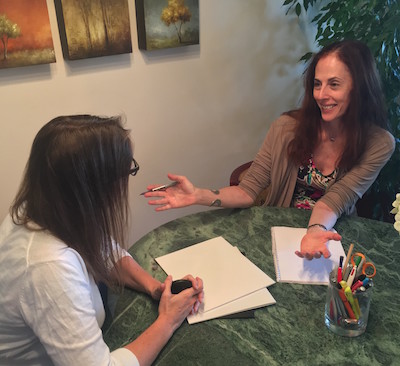
 Marguerite Elisofon is a New York City writer and the author of My Picture Perfect Family, a memoir about how her family navigated life with a child on the autistic spectrum before the internet and support groups existed. She also blogs about parenting young adults and disability related issues in The Never Empty Nest. Her writing has been featured in a variety of publications, including Time and NY Metro Parents magazine, and her family’s story has been featured by the NY Post, Fox News, The Daily Mail, and on Jenny McCarthy’s Dirty Sexy Funny radio show. A Vassar graduate, Marguerite was born and raised in New York City, where she still lives with her husband, Howard, in their mostly-empty nest. She is available to speak about a wide variety of issues relating to twins, parenting, and autism.
